 Subscribe: Gist E-Paper
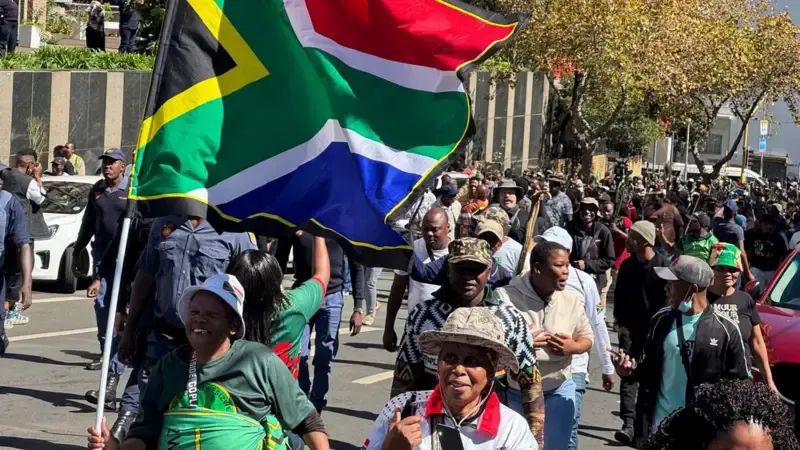
South African protesters have renewed calls for tougher immigration controls, with demonstrators in Pretoria demanding that the government ban Nigerians from entering the country.
The protest, organised by the March and March movement, took place on Wednesday in Pretoria amid growing tensions over immigration, xenophobia and the presence of foreign nationals in South African communities.
The protesters accused some Nigerians of involvement in drug trafficking and alleged that the activities of undocumented migrants were contributing to social and economic pressures confronting South Africans.
The demonstration was led by the group’s leader, Jacinta Ngobese-Zuma, who confronted the presence of Nigerians in Sunnyside, a Pretoria suburb with a sizable Nigerian population and popularly referred to by some as “Little Lagos.”
Addressing the protesters, Ngobese-Zuma questioned the basis for Nigerians identifying parts of the neighbourhood with names associated with their home country.
“I am being told here that we’ve entered Sunnyside, the home of Nigerians. I am inviting Nigerians to come out, let’s talk to each other. We want to know who gave you this place and called it Nigeria,” she said.
She also questioned who had given Nigerians the authority to refer to the area as Lagos or otherwise associate it with their homeland.
Her remarks reflected the increasingly hostile rhetoric surrounding the presence of Nigerian and other foreign communities in parts of South Africa.
Ngobese-Zuma argued that the current situation was “not sustainable and not feasible”, alleging that migrants were placing additional pressure on public resources and contributing to frustrations among South African citizens.
The movement said it would take its grievances to the Department of Home Affairs, where it plans to submit demands for stricter immigration controls, tighter restrictions on refugee admissions and faster deportation of undocumented foreign nationals.
The group’s legal representative, Xolani Zuma, made the strongest demand, calling for an outright ban on Nigerians entering South Africa.
“The state must ban Nigerians from South Africa. They must ban Nigerians until they stop selling drugs to our people. The rest of Africa, we are fine, but we do not want Nigerians in South Africa anymore,” he said.
The protesters also demanded that South Africa withdraw from the 1951 United Nations Convention Relating to the Status of Refugees, arguing that the country\\\\\\\'s obligations under the international agreement had become unsustainable.
The latest protest comes against the backdrop of longstanding tensions between Nigeria and South Africa over xenophobic attacks, immigration, the treatment of Nigerian nationals and broader diplomatic disagreements.
Relations between the two countries were also recently tested following a diplomatic dispute involving Nigeria’s High Commissioner to South Africa, Femi Fani-Kayode.
Fani-Kayode and the South African authorities became embroiled in a controversy after his prepared speech was reportedly excluded during the presentation of his credentials, an action the Nigerian envoy initially described as disrespectful to Nigeria.
The diplomatic disagreement was subsequently said to have been resolved following the intervention of South African President Cyril Ramaphosa and an invitation extended to Fani-Kayode by the country’s Department of International Relations and Cooperation.
Since assuming office, the Nigerian envoy has also raised concerns over issues affecting Nigerians living in South Africa.
Fani-Kayode has described those responsible for xenophobic attacks as a minority and maintained that they should not be allowed to define the character of South Africa or its relationship with Nigeria.
He has also expressed confidence that the two countries can overcome their differences and preserve their longstanding diplomatic relations.
However, the Nigerian envoy has warned that patience is running thin within Nigeria’s corridors of power over repeated attacks on its citizens.
He stressed that Nigeria would continue to defend its nationals and would not abandon them in the face of xenophobic violence.
The latest protest is therefore likely to attract renewed attention from both governments, particularly as Nigeria and South Africa remain major political and economic powers on the continent.
While the protesters have framed their demands around immigration, drugs and pressure on public resources, calls for a blanket ban on Nigerians raise broader questions about xenophobia, collective responsibility and the treatment of foreign nationals.
The challenge for the South African government will be to address legitimate concerns about illegal immigration and criminality without allowing allegations against individuals to become a basis for targeting an entire nationality.
For Nigeria, the latest development reinforces concerns over the safety and dignity of its citizens living and working in South Africa.
The two countries now face the delicate task of managing domestic political pressure while protecting bilateral relations and preventing renewed hostility from escalating into attacks against ordinary Nigerians and other foreign nationals.