
 Subscribe: Gist E-Paper
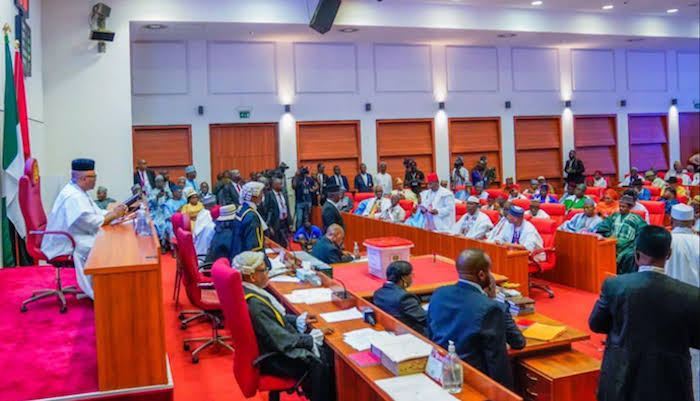
The Senate Minority Caucus has dismissed claims that the upper chamber rejected electronic transmission of election results during the passage of the Electoral Act amendment bill, insisting that lawmakers approved the electronic transfer of results in line with existing law.
Addressing a press briefing at the National Assembly on Thursday, Senator Enyinnaya Abaribe, a former Minority Leader, said the public backlash that followed the passage of the bill on Wednesday stemmed from a misunderstanding of the legislative process and the specific provision adopted by the Senate.
Abaribe explained that the controversy centred on Clause 60 of the bill, which deals with the transmission of election results. He said while the Senate voted down a proposal by the Senate Committee on Electoral Matters that sought to mandate real-time upload of polling unit results to the Independent National Electoral Commission’s (INEC) Result Viewing Portal (IReV), it did not reject electronic transmission altogether.
At plenary, senators declined to adopt the committee’s recommendation that would have compelled presiding officers to transmit results electronically to the IReV portal in real time after votes are counted and announced at polling units.
Instead, the Senate retained the provision already contained in the 2022 Electoral Act, which allows for the electronic transfer of results in a manner prescribed by INEC after votes are counted and announced at the polling unit.
During the debate, the Senate Chief Whip, Senator Tahir Mongunu, drew attention to the wording of the existing law and urged the chamber to retain the term “transfer” as provided in the 2022 Act. His position was immediately supported by Deputy Senate President, Senator Jibrin Barau, after which Senate President Godswill Akpabio endorsed the retention of the provision.
The retained section of the Act empowers presiding officers, after counting votes at polling units, to record results on forms prescribed by INEC, announce the results at the polling unit and provide copies of the completed forms to polling agents and security officials where available.
Clarifying the position of the Minority Caucus, Abaribe stressed that the Senate did not jettison electronic transmission of results.
“Yesterday, the Senate did not, I repeat, did not reject transmission of results as contained in the 2022 Act,” he said.
According to him, the lawmakers approved electronic transmission but rejected a version they considered vague or capable of misinterpretation.
“We want a law that is clear, concise and unambiguous on electronic transmission of results,” he added.
Abaribe said the provision emerged from an extensive amendment process involving joint committees of the Senate and House of Representatives, with contributions from INEC and civil society organisations. He noted that several retreats and engagements were held in Abuja and other locations, where stakeholders agreed that electronic transmission of results remained the preferred option.
He further disclosed that after the report of the Senate Committee on Electoral Matters was submitted, an ad hoc committee was set up to review it, and its recommendations were considered during a closed-door executive session.
“On the honour of all of us standing here, the Senate committee, the ad hoc committee and the executive session agreed on electronic transmission of results,” Abaribe said.
He attributed the confusion during plenary to movements and side conversations in the chamber, which created the impression that electronic transmission had been rejected.
Abaribe also pointed out that the harmonisation committee set up to reconcile differences between the Senate and House versions of the bill has not commenced work, as the Votes and Proceedings of the sitting are yet to be adopted.
“When we pass the Votes and Proceedings, we will insist that what we approved—electronic transmission—is clearly reflected,” he said.
Supporting his position, Senator Abdul Ningi noted that the amendment process began in September 2024 and involved about 27 public hearings across the country, describing it as misleading to suggest that public input was ignored.
Other senators present at the briefing included Ireti Kingibe, Natasha Akpoti-Uduaghan, Aminu Tambuwal, Victor Umeh, Tony Nwoye, Austin Akobundu and Binos Yaroe, among others.
Earlier on Wednesday, Senate President Akpabio had also dismissed reports that the Senate rejected electronic transmission of results, insisting that the chamber merely retained the provision in the 2022 Electoral Act.
He said the law still allows for electronic transmission of results and warned against what he described as attempts to mislead the public.
The issue of electronic transmission of election results remains one of the most contentious aspects of Nigeria’s electoral reforms since the 2023 general elections, with civil society groups and opposition parties continuing to push for clearer legal provisions to strengthen transparency and public confidence in the electoral process.